


TLDR: A marketing attribution model is a way of assigning value to every touchpoint in a customer’s journey, from first interaction to final purchase. Without attribution, you risk over-investing in the final click and under-valuing the channels that drive awareness and consideration. Single-touch models are simple but limited. Multi-touch attribution (MTA) offers more granular insight, while marketing mix modelling (MMM) provides a broader, top-level view of marketing impact.
Table of Contents
What is a marketing attribution model?
A marketing attribution model is a framework used to assign value to each interaction a customer has with your brand before making a purchase. From the moment someone first encounters your brand, whether through an ad, social post, video, or even offline media, to the point they convert, attribution models determine how much credit each step in that journey deserves.
It is essentially “a way of assigning value to everything that was in a customer journey,” allowing you to attribute purchase revenue back across the entire path that led to it.
Without attribution, marketers often default to assuming the last click deserves full credit. In reality, the journey is rarely that simple. Customers may see multiple ads, engage with different channels, and interact with your brand several times before converting.
Why marketing attribution models matter
Marketing attribution models matter because they directly influence how budget is allocated. If you do not accurately measure contribution across channels, you risk investing heavily in the wrong areas. In marketing terms, the final click may close the deal, but awareness and consideration channels laid the groundwork.
Without attribution, businesses may incorrectly assume one channel is solely responsible for performance and funnel all investment into it. Attribution ensures you recognise the full team effort behind conversions.
Types of marketing attribution models
There are several types of attribution models, each with strengths and limitations. Choosing the right one depends on your data maturity, marketing mix, and reporting needs.
Single-touch attribution models
Single-touch attribution models assign 100 percent of the credit for a conversion to one touchpoint. The two most common versions are:
First-click attribution, which assigns all credit to the first interaction that introduced the customer to your brand.
Last-click attribution, which assigns all credit to the final interaction before conversion.
These models are simple to implement and easy to understand. However, they oversimplify the customer journey. By focusing on only one interaction, they ignore the influence of all other marketing activity along the way.
Multi-touch attribution (MTA)
Multi-touch attribution distributes credit across multiple interactions in the customer journey. Instead of rewarding only the first or last click, it assigns value to each step along the path.
Different multi-touch models distribute credit in different ways. Linear models divide credit evenly. Position-based models (sometimes referred to as bathtub or U-shaped models) give more weight to first and last interactions. Data-driven attribution (DDA) uses algorithmic analysis to assign credit based on observed impact.
Today, platforms like Google Analytics 4 primarily support data-driven attribution as the default option. Many organisations are effectively constrained to DDA if they are using GA4.
The key limitation of traditional MTA is that it is typically click-based. This means that non-click interactions, such as TV ads or video views, may not receive proper credit unless view-based modelling is incorporated.
Advanced attribution approaches
Advanced attribution approaches go beyond click-based models. One common limitation of MTA is that it ignores impressions or offline media that cannot be clicked, such as TV campaigns, YouTube views, or out-of-home advertising.
By introducing view-based modelling, marketers can start measuring the impact of non-click interactions. This allows brands to better understand the contribution of upper-funnel campaigns that drive awareness but may not generate immediate clicks.
Additionally, integrating offline data through CRM systems like Salesforce or HubSpot enables tracking beyond form fills. Online attribution may stop at the point of lead capture, but feeding offline sales data back into your measurement system ensures the full journey is captured.
Marketing mix modelling (MMM) vs multi-touch attribution (MTA)
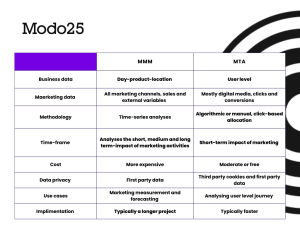
Multi-touch attribution (MTA)
Multi-touch attribution is granular. It typically evaluates individual conversions and assigns revenue back to specific touchpoints. It is useful for understanding performance at the conversion level and optimising tactical spend.
Marketing mix modelling (MMM)
Marketing mix modelling takes a broader view. Instead of focusing on individual conversions, it analyses overall marketing activity and its impact on total sales performance over time.
For example, if you run a large two-month YouTube or TV campaign, MMM can help you understand the overall uplift in brand performance and revenue. It works well for evaluating upper-funnel or offline activity that does not fit neatly into click-based attribution.
In short, MTA is granular and conversion-focused. MMM is holistic and top-level. Rather than choosing one over the other, they are most powerful when used together.
How to choose the right attribution model
In practice, your choice may be influenced by your technology stack. Many businesses using Google Analytics 4 default to data-driven attribution due to platform constraints.
However, the decision should also consider your business model. If you rely heavily on upper-funnel campaigns or offline media, pairing multi-touch attribution with MMM will provide a more balanced view. If your focus is short sales cycles and performance marketing, a robust multi-touch model may be sufficient. Ultimately, the “right” model is the one that aligns with your measurement goals, available data, and marketing mix.
The best marketing attribution tools
For many brands, Google Analytics 4 acts as the core attribution engine. Its data-driven attribution model is widely used and accessible. Beyond that, exporting click data into measurement platforms such as ASK BOSCO allows marketers to build and experiment with different attribution models.
When offline conversions are part of the customer journey, integrating CRM systems like Salesforce or HubSpot ensures that post-form-fill sales activity is fed back into the attribution system. It is worth noting that building entirely custom attribution models within platforms is becoming less common. Instead, many marketers rely on default data-driven approaches supported by their analytics stack.
Best practices for implementing attribution modelling
Successful attribution modelling depends as much on process as it does on tools. First, establish a single source of truth for performance measurement. Having multiple conflicting reports leads to confusion and poor budget decisions.
Second, use multi-touch attribution where possible and pair it with MMM to avoid missing large portions of your marketing impact. Third, ensure proper UTM tagging across all campaigns. Clean and consistent tagging guarantees accurate channel tracking and reliable data.
Finally, if your sales process extends offline, connect CRM systems and feed conversion outcomes back into your analytics environment. Without this, you are only measuring part of the journey.
Conclusion
Marketing attribution models are essential for understanding how your marketing actually drives revenue. They prevent over-reliance on the final click and ensure all touchpoints in the customer journey receive appropriate credit.
Single-touch models offer simplicity but limited insight. Multi-touch attribution provides a granular, conversion-level understanding. MMM delivers a broader, strategic perspective. The most mature organisations combine both approaches, maintain a single source of truth, implement strong tagging practices, and integrate offline data where necessary. If you’re looking for more information on marketing attribution models or MMM, let’s talk. Get in touch with our team at team@modo25.com.