


TLDR: Competitor PPC analysis helps you figure out who’s bidding against you, why your costs are changing, and how to use that knowledge to protect your brand, save money, and find smarter opportunities. By keeping an eye on the competition, you can decide whether to fight harder for certain keywords or step away and invest your budget where it will have more impact.
Table of Contents
What is competitor PPC analysis?
At its core, competitor PPC analysis is about knowing who else is bidding on the same keywords as you in platforms like Google Ads or Microsoft Ads. Because PPC works like an auction, the more players you have in the game, the more expensive those keywords become.
Take niche financial services, for example. Even one competitor can completely change the cost of bidding because search volume is so small. On the other hand, if you’re in a space like “white trainers,” there are thousands of searches a day, so the effect of one extra bidder is diluted. Either way, keeping track of who’s showing up alongside you is key to understanding why your CPCs rise or fall, and what you might need to do about it.
Why you should analyse competitors’ PPC strategies
Looking at what your competitors are doing isn’t about copying them. It’s about making smarter choices with your own budget. If you know a certain keyword is crowded, costs a fortune, and rarely converts, you may decide it’s simply not worth the fight. On the flip side, if protecting your brand image is non-negotiable, like in luxury retail, you might pull budget away from generic terms and push it into brand campaigns, just to make sure you’re always top of the page.
When you know who’s inflating your CPCs, you stop feeling like costs are climbing for no reason. Competitor analysis lets you make sense of the shifts and respond accordingly. Sometimes that means pushing the budget harder to squeeze out smaller rivals. Other times, it means stepping back and finding more efficient opportunities.
What to look for in a competitor PPC analysis
When you’re digging into competitor activity, one of the biggest signs is a sudden spike in your CPCs. More often than not, that means someone’s entered the auction with a big budget and is bidding aggressively. The way to confirm that is by heading to Google’s Auction Insights. This report shows you things like your impression share, how often you’re outranking others, and which competitors are showing up most often alongside you.
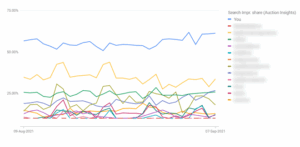
It’s also important to look at brand terms separately from generic ones. You’ll want to know if rivals are bidding on your brand name, because that has a direct impact on your visibility. For generic keywords, the game is a little different. You might never beat the likes of Amazon on broad terms, but on your brand keywords you can usually keep hold of that top spot, if you’re prepared to defend it.
And don’t overlook the creative side. Studying competitor ad copy tells you how they’re positioning themselves and where you can differentiate.
Tools for competitor PPC analysis
You don’t need to reinvent the wheel, the right tools make competitor monitoring much easier:
- Google Ads Auction Insights – Your first stop. Shows impression share, overlap, outranking, and more.
- Adthena – Paid tool that scrapes search results to reveal competitor ad copy, keywords, and bidding intensity.
- SimilarWeb – Originally SEO-focused, but offers a holistic picture of traffic share (organic + paid).
- ASK BOSCO® – Useful for benchmarking and high-level insights, especially for C-Suite reporting.
Step-by-step: How to do a competitor PPC analysis
Here’s a simple process you can follow:
- Open up Auction Insights and pull a search impression share report.
- Segment the data into pure brand terms, broader brand terms, and generic keywords.
- Compare your performance in search vs shopping campaigns, since the dynamics can be very different.
- Look at overlap rates, outranking share, and position-above rate to see who’s winning more often.
- Check for CPC spikes and match them to competitor activity.
- Use third-party tools to fill in the gaps, like estimating ad spend or checking competitor ad copy.
- Decide on quick wins: where should you pull back, and where should you push harder?
How to use competitor insights in your PPC strategy
The real power of this analysis comes when you apply it. Let’s say you find out a smaller rival is aggressively bidding on your brand terms. If you have the budget, you could respond by bidding even harder, making it unsustainable for them to compete. On the other hand, if you discover that generic terms are costing you more than they’re worth, you might redirect that budget into brand campaigns or into new, less competitive opportunities.
Sometimes the takeaway isn’t about bids at all, it’s about messaging. If you see your competitors highlighting free shipping, financing options, or sustainability, you might rethink your own ad copy to stand out. The point is, the data gives you choices, and those choices should align with your overall goals, not just your instinct to “beat” someone else.
Common mistakes to avoid
One of the biggest traps is reacting too quickly. Competitors sometimes appear aggressively for just a week or two, maybe testing a campaign or capitalising on a short-term sale. If you overhaul your whole strategy in response, you risk wasting money.
Another mistake is forgetting what actually matters to your business. Not every client or brand has the same priorities. Some can afford to fight hard for visibility, while others need to focus purely on efficiency. And finally, don’t ignore the calendar. Competition always spikes around Black Friday, Christmas, Mother’s Day, and similar seasonal peaks depending on your industry. If you’re not prepared, you’ll be caught off guard.
Final thoughts
Competitor PPC analysis is never one-and-done, it’s an ongoing process. Get to know who your main competitors are, keep an eye on Auction Insights to see where they show up most, and regularly review their ad copy and landing pages to find ways to stand out. Remember that every client or brand will have different priorities, so tailor your analysis accordingly.
And finally, use the tools you have, whether that’s Google’s in-platform data, a third-party scraper, or a benchmarking platform. The key is to combine insights with strategy, so you’re not just watching the competition but using what you learn to make smarter moves in your own campaigns. Got questions about running a competitor PPC analysis? Please get in contact with our team, at Modo25, or you can email our team, team@modo25.com.