


TLDR: Google’s Universal Commerce Protocol (UCP), currently live in the US only, allows AI to complete purchases directly with retailers without sending users to websites. For SEO, this changes the rules. Visibility no longer guarantees traffic. Instead, success depends on how well your products, pricing and systems can be understood and selected by machines.
Important note: UCP is only available in the US right now. Google has not announced a UK launch date. However, based on previous Google rollouts, it’s reasonable for UK SEO teams to start preparing.
Table of Contents
What is Google’s Universal Commerce Protocol?
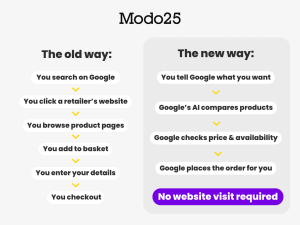
Google’s Universal Commerce Protocol (UCP) is a system that allows AI agents to interact directly with retailer systems to complete purchases.
Instead of:
- sending users to product pages
- relying on on-site UX to convert
- measuring success via sessions and clicks
UCP allows Google’s AI to:
- discover products
- compare options
- check availability and pricing
- place orders
All without the user ever visiting the retailer’s website. For users, this reduces friction. For SEO teams, it fundamentally changes where value is created.
SEO has always been about the click but UCP removes it
Historically, SEO has worked like this:
- Rankings drive visibility
- Visibility drives clicks
- Clicks drive engagement and conversion
Even as Google added SERP features and reduced organic space, the click still mattered. UCP breaks that model.
If a product can be discovered and purchased inside Google’s AI interface, then:
- traffic is no longer guaranteed
- on-site experience happens after the decision (or not at all)
- rankings exist to enable selection, not visits
What this means for SEO teams:
Success is no longer about “getting the user to the site”. It’s now about being the product the AI chooses.
Google is positioning itself between intent and purchase
Google has always moved value closer to its own ecosystem. We’ve already seen this with:
- featured snippets reducing clicks
- local packs capturing commercial intent
- shopping results replacing organic listings
UCP takes this a step further. Rather than intercepting clicks, it removes the need for them entirely by sitting directly between:
- user intent
- product decision
- transaction
From an SEO perspective, this continues a long-term trend: websites becoming infrastructure rather than destinations.
What this means for SEO teams:
Your site still matters, but increasingly as a data source and transaction layer, not the primary discovery experience.
SEO becomes a data discipline before it’s a content one
AI agents don’t consume websites like humans do. They rely on:
- structured data
- product feeds
- APIs
- real-time pricing and availability
In a UCP-driven environment, visibility depends on whether your systems are machine-readable, accurate and consistent. This shifts SEO priorities significantly:
- Technical SEO becomes foundational, not supportive
- Structured data is mandatory, not optional
- Product accuracy directly impacts organic visibility
- Merchandising and SEO become tightly linked
SEO teams will need to work much more closely with:
- developers
- product teams
- data and merchandising teams
What this means for SEO teams:
If your feeds, inventory data or pricing logic are unreliable, your visibility will suffer, regardless of content quality.
The trust and risk problem with UCP
UCP doesn’t just recommend products, it enables AI to transact on behalf of users. That introduces risk.
Potential issues include:
- incorrect pricing being actioned
- orders placed for the wrong products
- sensitive commercial data being exposed
- transactions happening outside your controlled UX
While the protocol may be technically “open”, early adoption will favour large platforms with their own incentives. If things go wrong, it’s likely that retailers will carry the operational and reputational impact.
What this means for SEO teams:
Organic visibility now has governance and risk implications. SEO can no longer operate in isolation from security, legal or engineering teams.
Why this shouldn’t surprise experienced SEOs
From a strategic point of view, UCP isn’t unexpected. Google has always:
- centralised value
- reduced reliance on external websites
- expanded its role across the funnel
AI allows Google to move faster than before, often before industries have fully adapted. UCP fits that pattern: powerful, ambitious, and rolled out before the long-term consequences are fully understood. It’s important to know that this isn’t the end of SEO, but it is the end of SEO as a purely traffic-led channel.
What SEO practitioners should be doing now
UCP doesn’t require panic, but it does require preparation for when this rolls out to the UK. SEO teams should start by:
- shifting focus from pages to systems
- auditing product data quality and consistency
- strengthening structured data and feeds
- rethinking measurement beyond clicks and sessions
More broadly, businesses need to decide:
- how much control they’re willing to give up
- whether AI-led transactions align with brand strategy
- where SEO sits within infrastructure and governance conversations
Even though UCP is US-only today, the direction of travel is clear. SEO success is becoming less about being found by people and more about being selected by machines.