
TLDR: Micro and macro influencers serve different purposes in paid social, and the right choice depends on your objective, audience, and budget. This guide gives you a clear framework for making the decision, briefing each type correctly, and turning influencer content into high-performing paid social ads.
Understanding the influencer tiers and what each delivers
Before you brief a single creator, it helps to understand what each tier is actually built for.
- Nano (1k–10k followers): Highly engaged, tight-knit audiences. Strong for local or niche brands and affiliate-style campaigns.
- Micro (10k–100k followers): The sweet spot for most paid social campaigns. Higher engagement rates, genuine audience trust, and strong niche authority.
- Macro (100k–1m followers): Broader reach and greater brand visibility. Useful for awareness campaigns, but engagement rates tend to drop as audiences grow.
- Mega (1m+ followers): Maximum scale. Think brand moments and cultural visibility rather than conversion-focused performance.
One thing to be clear on from the start: follower count alone is an unreliable guide. Engagement rate and audience alignment matter far more than a large number on a profile. A micro influencer whose audience closely matches your buyer persona will almost always outperform a macro influencer talking to the wrong people.
Step 1: Define your campaign objective before choosing a tier
The single biggest mistake in influencer marketing is picking a tier before you know what you are trying to achieve. Choose the tier first and you are working backwards. Define the objective first and the right tier becomes obvious.
Here is a simple framework:
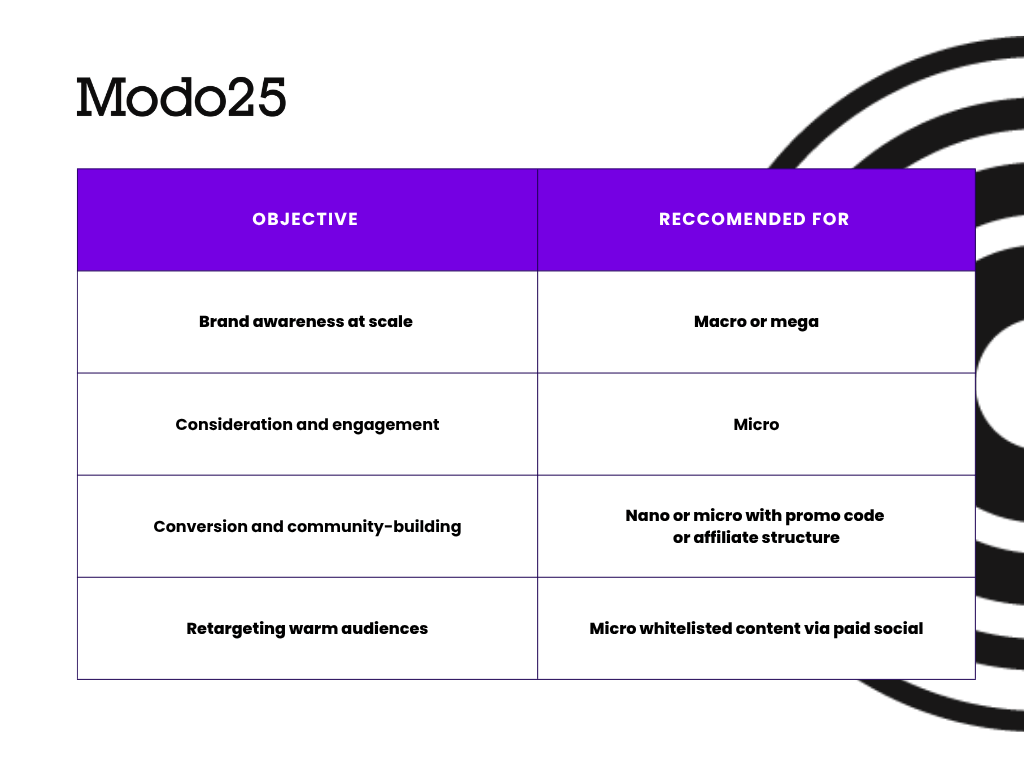
Start by asking whether this campaign is primarily about reach or results. If it’s reach, go macro. If results,measurable clicks, conversions, or cost-per-purchase, go micro and build a whitelisting strategy around their content (more on that in Step 4).
Step 2: Evaluate influencers on the right criteria
Once you know your objective and tier, the next step is finding the right creators within that tier. Here is what to look at beyond follower count.
Engagement rate
Calculated as (likes + comments) ÷ followers. A healthy engagement rate for a micro influencer is typically 3–6%. Anything below 1% on a large account is a warning sign.
Audience demographic alignment
Does their audience actually match your buyer? Use Instagram Insights, TikTok Creator Marketplace, or AWIN’s creator tools to verify age, location, and gender split before committing budget.
Content quality and consistency
Scroll back three to six months. Is the quality consistent? Are they posting regularly? Sporadic posting or a sudden shift in content style can signal an audience that has disengaged.
Previous brand partnerships
Are they selective about what they promote? Creators who work with ten brands a month tend to have audiences that have learned to scroll past the ads. Genuine selectivity builds credibility.
Product affinity
Has the creator shown genuine interest in your category, even without a paid partnership? Authentic enthusiasm is something an audience can always tell and it shows up in the content.
Step 3: Brief influencers for paid social performance, not just organic reach
This is where most influencer campaigns lose value. An influencer briefed for organic reach will produce content designed to perform on their feed. That is not the same as content designed to perform as a paid social ad.
A paid-social-focused brief should include:
- Hook requirements. The first two to three seconds are everything in paid social. Specify exactly how you want the video to open, whether that is a direct question, a bold statement, or a product reveal.
- Key message hierarchy. What is the one thing the viewer must take away? List your messages in order of priority so the creator knows what to lead with and what is secondary.
- Clear CTA. Tell viewers specifically what to do next, visit the link in bio, use a promo code, swipe up. Vague CTAs produce vague results.
- Usage rights for paid amplification. If you plan to whitelist the content or run it as a Spark Ad, confirm usage rights upfront. This should be written into the contract before any content is created.
The difference between a brand awareness brief and a conversion brief comes down to specificity. Awareness briefs give creators more creative latitude. Conversion briefs need tighter guardrails around the hook, message, and CTA.
Step 4: Set up whitelisting or Spark Ads to amplify their content
Whitelisting and Spark Ads are among the most underused tactics in influencer marketing. Done well, they let you take a creator’s organic content, which already has authentic feel and proven engagement, and run it as a paid ad from their handle.
Meta whitelisting (partnership ads)
- Ask the creator to grant you ad access via Meta’s Creator Studio or Business Suite under “Partnership Ads.”
- Once access is granted, go to Ads Manager and select “Use partner’s handle” when setting up your ad creative.
- The ad will run from the creator’s account, not your brand page, which typically improves trust and click-through rate.
- You can then apply all standard Meta targeting on top of their content.
TikTok Spark Ads
- Ask the creator to generate a Spark Ads code from their TikTok account (Settings > Creator tools > Ad settings).
- They set an authorisation window (typically 30–365 days).
- In TikTok Ads Manager, select “Spark Ad” as your ad type and enter the code.
- You can now boost their organic post as a paid ad, complete with their existing likes and comments visible, which adds immediate social proof.
Both formats require usage rights to be agreed on up front. Build this into the creator contract before briefing begins.
Step 5: Measure influencer performance for paid social
The metrics you track should match your original objective. Tracking conversion rate on an awareness campaign, or reach on a conversion campaign, tells you nothing useful.
For awareness campaigns
Focus on reach, video views, and view-through rate. These tell you how many people saw the content and whether they stayed to watch it.
For consideration campaigns
Track engagement rate and click-through rate. Are people interacting with the content? Are they following through to your site?
For conversion campaigns
Cost per purchase and ROAS from whitelisted ads are your primary signals. Supplement these with promo code redemptions and unique UTM-tracked URLs for each creator, so you can attribute revenue directly.
One important caveat: last-click attribution consistently undervalues influencer content. A viewer who watches a creator’s video, visits your site three days later via a Google search, and then converts will not show up in your influencer attribution. This is why influencer performance looks weak on last-click models and why MMM (Marketing Mix Modelling) gives a far more accurate picture of the true contribution influencer activity makes to revenue.
Step 6: Decide whether to continue, scale, or switch
After each campaign, work through this simple decision framework before deciding what to do next.
Strong engagement, low conversion?
The creator may be better suited to top-of-funnel awareness work. Their audience is engaged but not yet in buying mode, or the conversion brief needs tightening.
Strong ROAS from whitelisted content?
Scale it. Increase the paid spend behind their best-performing creative and approach them for additional content. A creator whose whitelisted posts outperform your standard brand creative is a genuine asset.
Low engagement and low conversion?
Move on. The audience is not aligned or the content is not landing. Do not pour paid budget behind organic content that has already shown it does not resonate.
The broader principle: treat influencer marketing as an ongoing roster, not a series of one-off activations. The brands seeing the best results are those who build long-term relationships with a core group of creators, test content consistently, and use paid amplification to scale what works.
Ready to build a more intelligent influencer strategy?
Choosing the right creators is only the starting point. Turning their content into a high-performing paid social channel takes the right brief, the right measurement framework, and a clear plan for scaling what works.
Our Paid Social team works with brands to do exactly that, from creator selection and whitelisting set-up to campaign measurement and ongoing optimisation. Get in touch with Modo25 to find out how we can help.